The 56 Minor Arcana: four suits, four ranks, and the 1491 deck Pamela Colman Smith borrowed from
Published 18/08/2026 · 4 min read
The Majors describe the big movements; the Minors describe this week. This piece explains the four suits, how to read the court cards, and the little-known story of where the familiar Minor Arcana pictures came from.
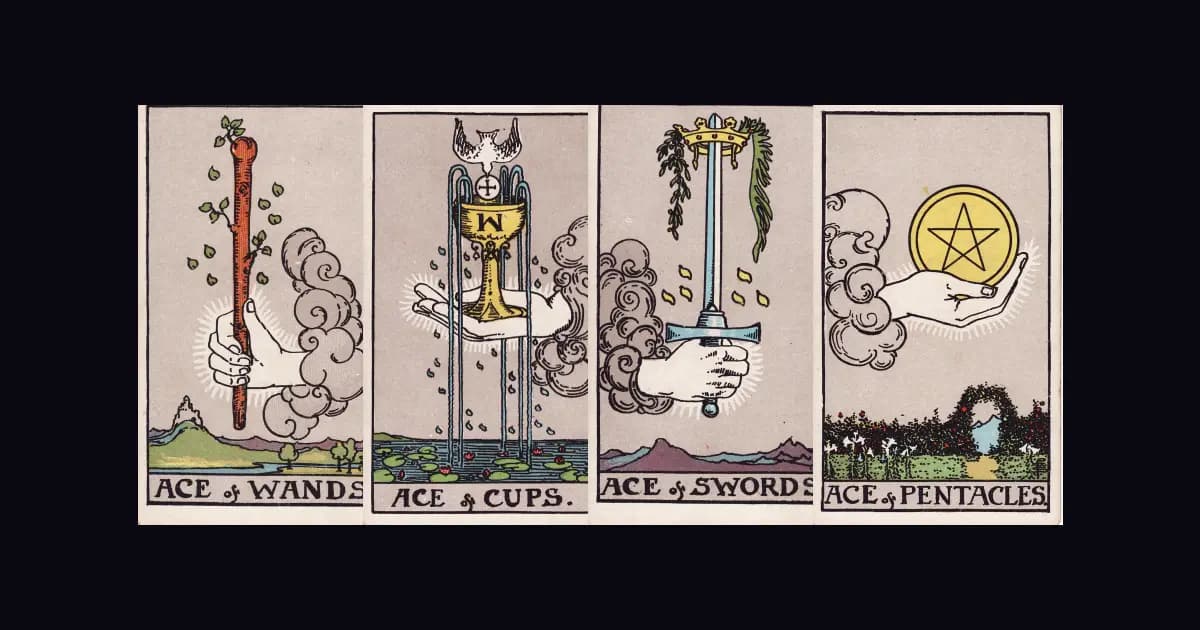
Of the 78 cards, 56 are Minor Arcana, more than two thirds of the deck. Beginners tend to pour their attention into the 22 Majors because the names are dramatic, and find the rest dull. But in most readings most of the cards drawn will be Minors, and they are the part that speaks about ordinary life.
Four suits, four areas of life
- Wands: action, drive, things just starting. Hot, fast, easily burnt out.
- Cups: feelings and relationships, what you actually feel rather than what you have decided you ought to feel.
- Swords: thought, speech, conflict. Sharp, and often painful in use.
- Pentacles: work, money, health, the things that have to be done again next week.
A quick way to remember them: they are the four suits of the ordinary playing deck. Wands became clubs, Cups hearts, Swords spades, Pentacles diamonds. The deck you play cards with is a relative of tarot that lost the 22 Majors and one court card per suit.
The dominant suit says more than any single card
Before reading individual cards, count the suits. A spread with three Swords and one Cup usually means a situation being thought about more than felt: you have analysed it thoroughly and not yet asked yourself how you feel. That alone is an answer, before any card is interpreted.
A spread of all Pentacles, on the other hand, often shows that a question you took to be about the spirit is really very concrete: money, health or time. And a missing suit is worth noticing too. A question about a relationship that draws no Cups at all deserves a pause.
The 1491 deck behind the familiar pictures
The piece on the Majors on this site says Pamela Colman Smith was the first to paint a scene with people for every Minor card. That is nearly true, with one notable exception, and the story behind it is a good one.
Around 1491, in northern Italy, someone made a tarot deck in which every card, the 56 Minors included, was a fully painted scene. It came to be called the Sola Busca, after the Milanese noble family that later owned it. For centuries it was the only such deck anyone knew of.
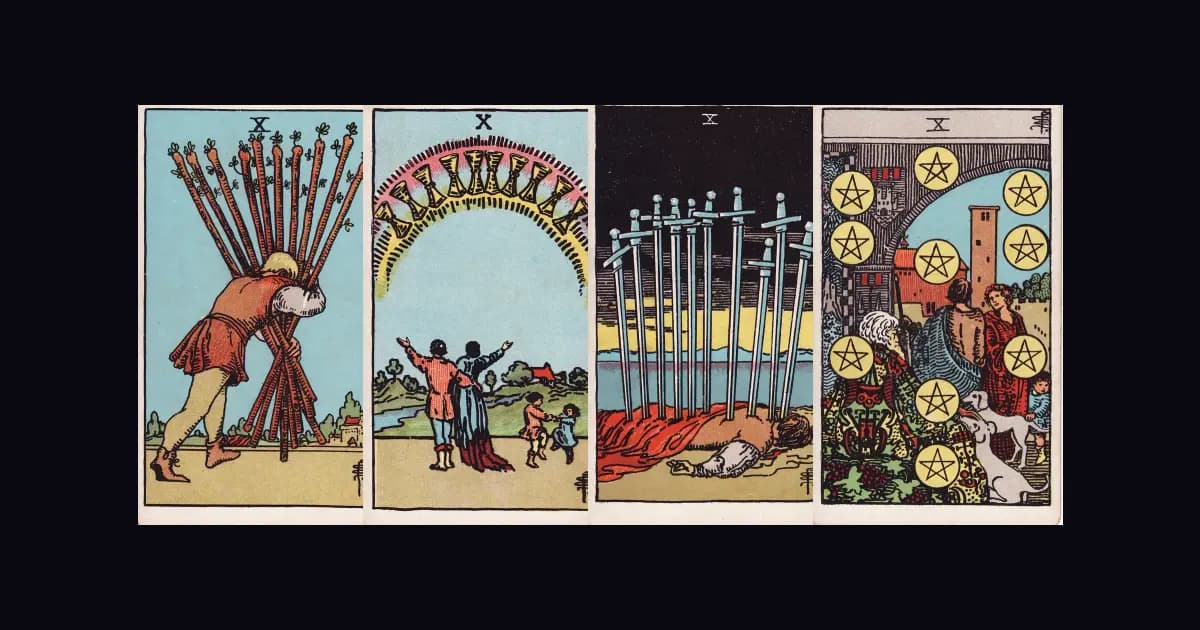
In 1907 the British Museum in London put photographs of the Sola Busca on display. Two years later Smith began painting Waite's deck. Tarot historians comparing the two have found several of Smith's cards that take their composition almost directly from the Sola Busca. The Three of Swords, a heart pierced by three blades, and the Ten of Swords, a man face down under ten swords, are the examples most often cited.
None of this diminishes Smith. She drew on a four-hundred-year-old deck that almost nobody of her day knew, then did what it had not: turned painted scenes into moments an ordinary person could read. But it is a useful reminder when you read the cards that the pictures in front of you have a long history, and every detail in them was somebody's choice.
Four ranks, and a trick for the court cards
Each suit has ten numbered cards, Ace to Ten, and four court cards: Page, Knight, Queen, King. The easiest way to hold them: the Page is learning, the Knight is overdoing it, the Queen has mastered it inwardly, the King has mastered it and answers for it outwardly.
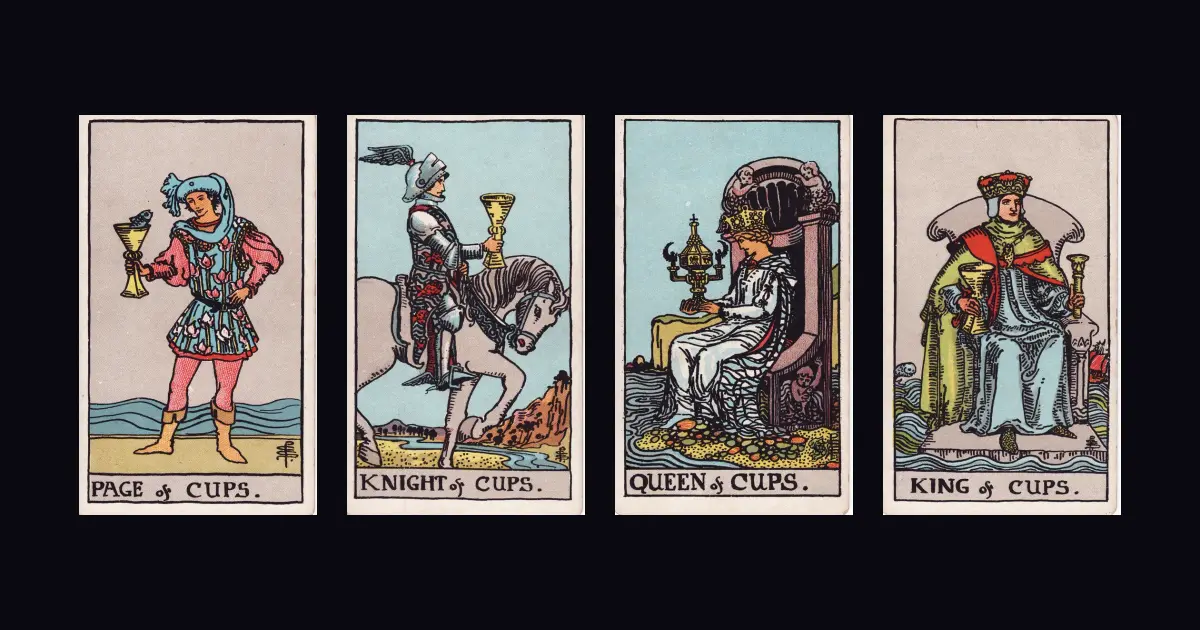
With court cards, the useful question is not "who is this" but "which part of me is behaving like this". A Knight of Swords is not necessarily someone else. Quite often it is you, charging into an argument that did not need to happen.
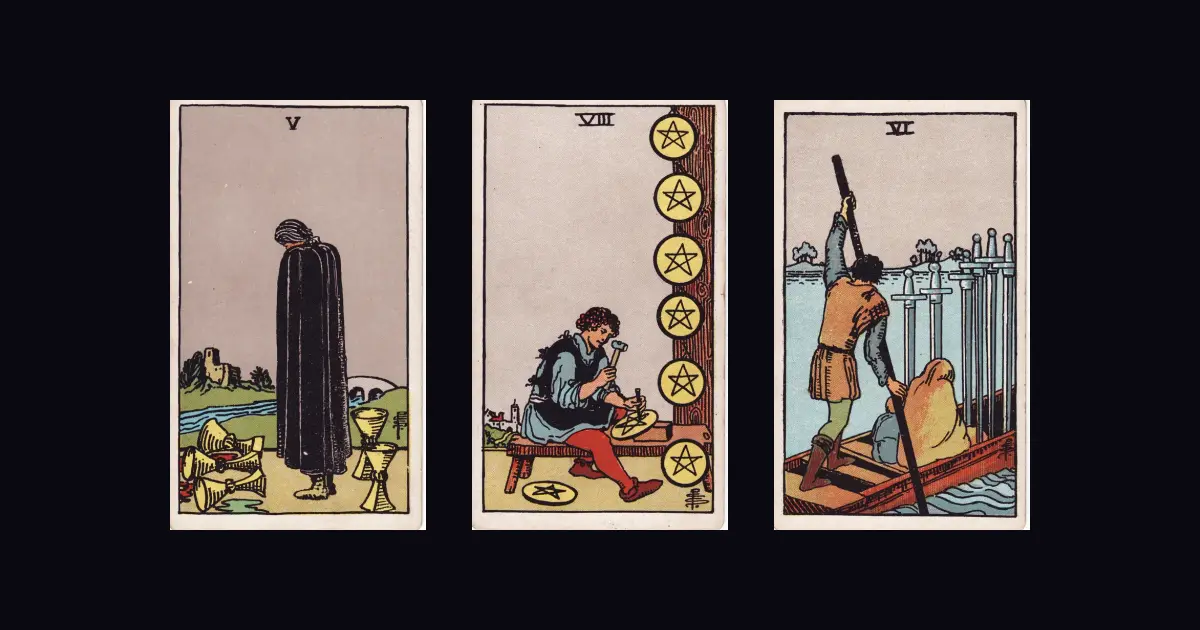
With the numbered cards, watch the number. The Ace is the suit in its pure beginning, the Five is often the hardest point midway, the Ten is the end. Know where a card sits on its suit's road and you have half its meaning before you open a book.
Tarot
How to read tarot at home as a beginner: six steps and one complete worked reading
You do not need a gifted deck, candles, or 78 meanings by heart. This walks through six steps, then does one real reading for the question “should I change jobs this year”, card by card.
20/09/2026 · 8 min read
Tarot
What reversed tarot cards mean: three schools, the man who first printed reversals on cards, and picking one to keep
What does an upside-down card mean? There are at least three widely used answers, and they contradict each other. This piece lays out all three, tells the story of the man who printed reversed meanings on cards in the 1780s, and names the one mistake worth avoiding.
23/08/2026 · 3 min read
Tarot
Which tarot spread to use: one card, three, or the Celtic Cross, and why more cards is not always better
Ten cards for a small question mostly adds noise, and makes it easier to find what you hoped to find. Here is how to match the spread to the question, plus the story of the 'ancient Celtic' spread that first appeared in 1910.
03/08/2026 · 4 min read