Tarot
Choose a spread, hold your question in mind, then draw. The full 78-card deck, shuffled in your own browser — nothing is sent anywhere or stored.
Pamela Colman Smith · Public domain
Writing the question down helps you focus while reading. It only ever appears on your own screen.
A reversed card usually means blockage, delay, or a turn inward.
About tarot
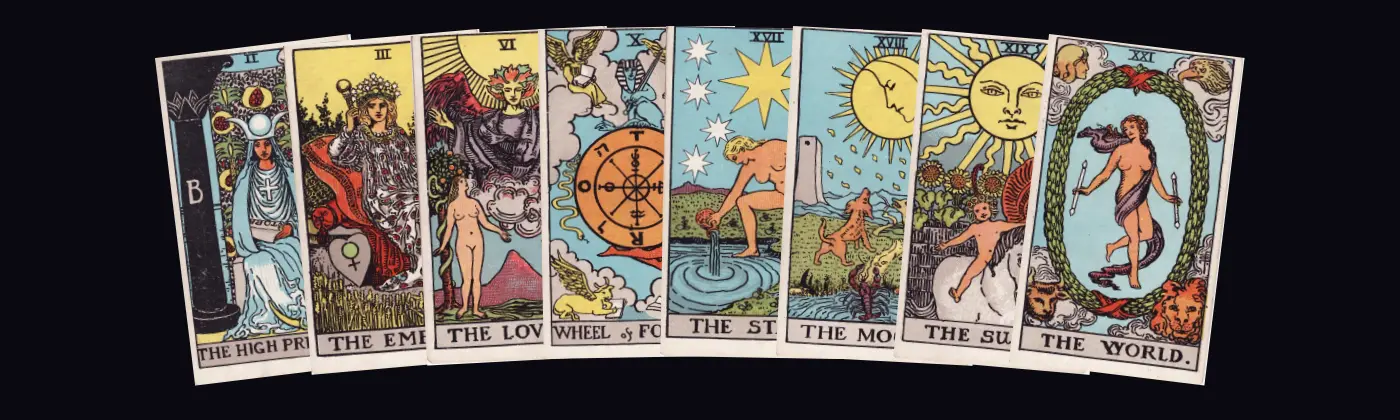
A tarot deck holds 78 cards. This site uses the Rider–Waite–Smith deck, drawn in 1909 by Pamela Colman Smith to Arthur Edward Waite's direction — the most widely recognised deck in the world, and the one nearly every modern reading style rests on.
The deck splits in two
Twenty-two Major Arcana, from The Fool to The World, deal in large movements: a chapter ending, something that has to be faced, a change that will not be undone. When several Majors turn up in one spread, the theme is usually larger than the question asked.
Fifty-six Minor Arcana divide into four suits of fourteen. Wands for action and drive, Cups for feeling and relationship, Swords for thought and conflict, Pentacles for work, money and the body. The Minors speak about this week, not about a life.
Choosing a spread
- One card — when you want something to carry through the day, or the question is still vague.
- Three cards, past–present–future — when you want to see which way a situation is running.
- Three cards, situation–action–outcome — when a specific decision is in front of you.
- The ten-card Celtic Cross — when the question has layers and you have time to sit with it.
A bigger spread does not give a better answer. It gives more detail, and against an unclear question more detail only muddles things.
How to ask
This decides the quality of the whole reading, and it is the part most often skipped. Yes-or-no questions produce thin readings. Instead of will he come back, ask what am I holding on to here. Instead of should I quit, ask what is keeping me here.
The card does not know what will happen. It hands you an image, and what you see in the image is the information.
The four suits in practice
Suits are worth knowing well, because most cards in any spread are Minors and the suit is the fastest read available. Wands run hot: energy, projects, the impulse to start. Cups run wet: attachment, grief, what you actually feel rather than what you have decided to feel. Swords run sharp: the arguments in your head, the words already said, the clarity that costs something. Pentacles run slow: rent, health, the work that has to be done again next week.
A spread weighted toward one suit is telling you where the question really lives. Four Swords and a Cup usually means a situation being thought about far harder than it is being felt — which is itself an answer.
On reversals
A card that lands upside down usually has its meaning slowed, blocked, or turned inward rather than outward. A reversal is not a bad card, and some readers drop reversals entirely. Either approach works, as long as you pick one and hold to it.
Tarot does not predict the future
Nothing suggests a randomly shuffled deck knows what is coming. What tarot does well is force you to state your own reaction: you draw The Tower and feel relief, or dread? The answer to that says more about you than any interpretation. If you are facing something genuinely serious — health, money, the law — ask someone qualified, and keep the cards for the conversation you are having with yourself.