Elements and modalities of the twelve signs: the second division most people miss, and why some pairs always clash
Published 19/07/2026 · 4 min read
Everyone knows whether their sign is Fire, Earth, Air or Water. Fewer know the second division, which goes back to Ptolemy, and it is the one that explains why Leo and Scorpio argue constantly and still find it hard to leave.
Ask someone who likes star signs which element theirs belongs to and most will answer at once. Ask whether it is cardinal, fixed or mutable and most will hesitate. That is a pity, because the second division is the one that explains the couples the first cannot.
The twelve signs are divided two ways at once: four elements and three modalities. Four times three is twelve, so every sign is a unique combination. Leo is fixed Fire. Sagittarius is mutable Fire. Taurus is fixed Earth. No two signs share both.
Four elements: the motive
Fire, Earth, Air and Water, three signs each, 120 degrees apart on the wheel. The element answers the question "what drives this person":
- Fire (Aries, Leo, Sagittarius): enthusiasm, the urge to act and to be seen.
- Earth (Taurus, Virgo, Capricorn): the concrete, the tangible, the lasting.
- Air (Gemini, Libra, Aquarius): ideas, conversation, connection.
- Water (Cancer, Scorpio, Pisces): feeling, attachment, what goes unsaid.
Three signs of one element form a trine, and same-element pairs tend to understand each other without much explanation. Fire and Air are held to suit each other, since wind makes a fire burn higher. So are Earth and Water, since water lets earth grow things.
Three modalities: the tempo
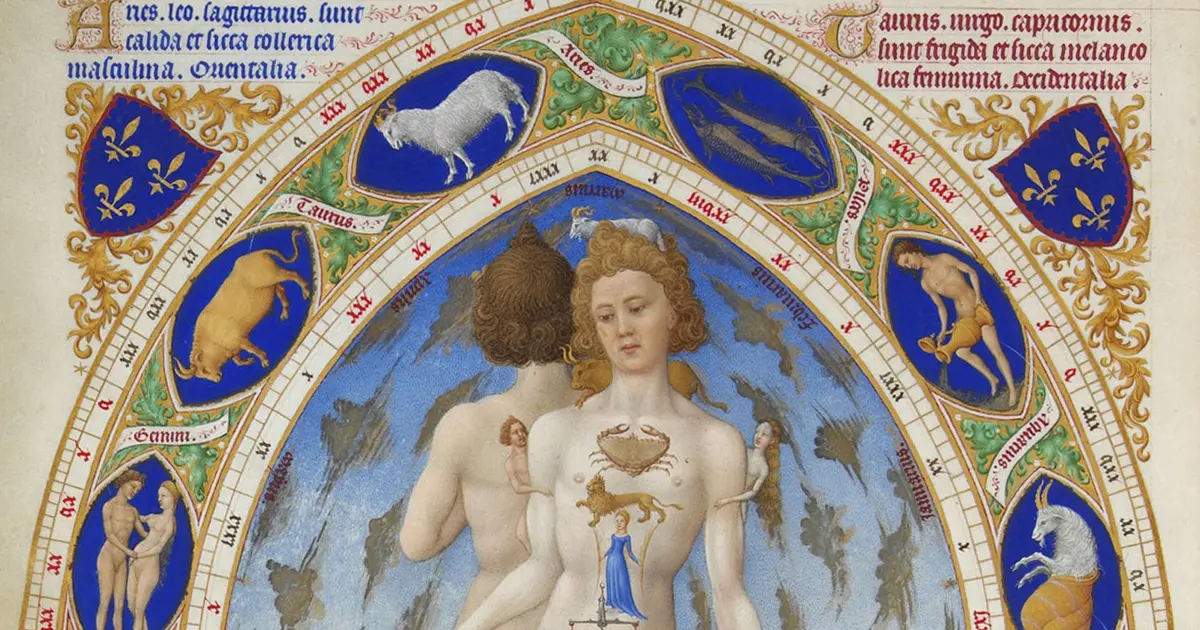
Modality answers a different question: at what tempo does this person act. It is tied to the seasons, and it is old. In the Tetrabiblos, written in Alexandria in the second century, Ptolemy already sorted the signs into those that open a season, solid ones, and "bicorporeal" or double-bodied ones. The last name sounds odd until you look at the pictures: Gemini is two brothers, Pisces two fish, Sagittarius half man and half horse. These are the signs that sit where one season turns into the next.
- Cardinal (Aries, Cancer, Libra, Capricorn): opening the four seasons. Good at starting, impatient with the middle.
- Fixed (Taurus, Leo, Scorpio, Aquarius): mid-season. Durable, loyal, and stubborn.
- Mutable (Gemini, Virgo, Sagittarius, Pisces): season's end. Quick to adapt, and easily scattered.
Why the square rubs
Put the two divisions together and a geometric rule appears. Two signs 90 degrees apart always share a modality and differ in element, and the two elements come from groups that do not sit well together. Leo and Scorpio are such a pair: both fixed, one Fire and one Water.
Picture such a couple arguing about the New Year holiday. The Leo wants the big family gathering, everyone there, being seen. The Scorpio wants a private trip, few people, depth. Both are fixed, so neither yields. And because their motives are so different, each finds the other's reasons baffling. That is the recipe for constant friction.
Yet precisely because both are fixed, neither leaves easily. Many astrologers observe that square pairs are the least peaceful and among the most lasting, since they keep forcing each other to grow. Opposite signs, 180 degrees apart, share a modality and have complementary elements, like Leo and Aquarius, so they tend to be two people who see in each other what they lack.
In 2011, the world briefly thought its signs had changed
In January 2011 the astronomer Parke Kunkle in Minnesota told a local paper something everyone in his field already knew: because of the precession of Earth's axis, the constellations have drifted from the positions the astrological calendar assigns them, and the Sun also passes through a thirteenth, Ophiuchus.
Within days the story had gone round the world. People panicked, believing their sign had changed. Some talked about removing tattoos.
Nobody's sign changed, because the claim compared two different systems. Western astrology uses the tropical zodiac, anchored to the spring equinox. It divides the year by season, not by constellation, which is also why the modalities belong to the start, middle and end of a season. Astrologers have known about the drift since the Greeks.
To argue against astrology you have to aim at what it actually claims: that positions at birth relate to character. In 1985 the physicist Shawn Carlson published a double-blind test in Nature in which astrologers were given real people's charts and personality profiles and asked to match them. They did no better than chance. That is the evidence worth discussing, not Ophiuchus.
Every sign page on Thấu Mình gives both element and modality. If you are wondering why you get on with one person and keep clashing with another, look at the modality line first.