Wabi-sabi: the beauty of imperfect things, Sen no Rikyu's two-mat tea room, and living with the cracks
07/09/2026 · 4 min read
In the late sixteenth century Toyotomi Hideyoshi, the general who had just unified Japan after more than a century of civil war, had a portable tea room built. Walls, ceiling and even the tea utensils were covered in gold leaf. He took it to important occasions so guests could see his power.
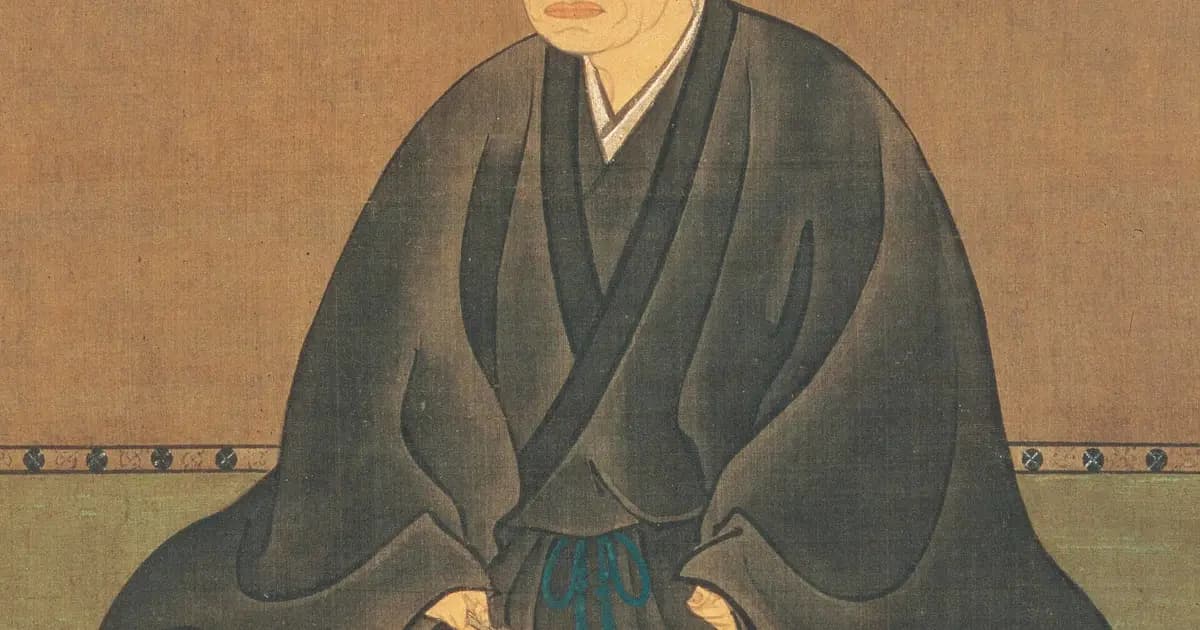
The tea master who served him, Sen no Rikyu, favoured something entirely different. The most famous tea room linked to his name, Taian, measures two tatami mats, about three square metres. The entrance is so low that every guest, samurai or merchant, had to leave their sword outside and crawl in bent double. The bowls were hand-shaped raku ware, rough and uneven, black or earthy red.
The single morning glory
A story about the two men has been retold for centuries. Hideyoshi heard that the morning glories in Rikyu's garden were blooming beautifully and announced he would come to see them. When he arrived that morning, every vine had been cut back. Irritated, he stepped into the tea room. In the alcove, in a plain vase, stood a single morning glory.
The story may have grown in the telling. But it makes Rikyu's view plain: one flower, placed right, fading within the day, is more worth looking at than a whole trellis. The beauty lies in its being few, fragile, and brief.
What wabi-sabi actually is
The two words began separately. Wabi first described a simple, solitary life far from the city, and gradually came to mean a deliberate plainness. Sabi described the beauty of things aged by time: the patina on bronze, weathered wood, moss on a stone step. Together they form an aesthetic that prizes three things modern culture treats as flaws: imperfection, impermanence, incompleteness.
It is not a consoling philosophy. It is a statement about reality: everything is ageing, everything will end, and nothing is truly finished. Wabi-sabi only adds that if this is true, fighting it is an exhausting way to live.
Nothing lasts, nothing is finished, and nothing is perfect. A common modern summary of wabi-sabi.
The broken bowl worth more than the whole one
Japan has the craft of kintsugi: a broken bowl is rejoined with lacquer mixed with powdered gold, and the cracks are not hidden but made to shine. One story of its origin: in the fifteenth century the shogun Ashikaga Yoshimasa sent a treasured cracked tea bowl to China for repair and got it back held together with crude metal staples. Japanese craftsmen were asked to find a more beautiful way, and kintsugi was born.
Vietnamese potters know a similar idea. Bát Tràng crackle-glaze ceramics have fine cracks running across the glaze, and the potters create them on purpose. A crackle vase is not considered damaged. The cracks are what give it its value.
Why it is hard for us
We grow up surrounded by edited images. The kitchen in the photo has no stains, the face has no lines, the career in the post has no plateau. After years of seeing that every day, imperfection starts to feel like a bug to fix rather than the normal state of things.
Three places to try it now
- Your home: keep one old thing you were about to replace only because it is old. Look at it for another month before deciding.
- Your work: send the draft at eight tenths instead of waiting for ten. The last tenth usually costs more time than the value it adds.
- Yourself: next time the mirror shows a sign of age, try seeing it as evidence of time lived rather than of something being lost.
The last is the hardest, and the only one that really matters. Wabi-sabi is easy to apply to a bowl. Applying it to yourself means dropping a deep belief: that you will be more worthy of living once you have fixed everything that is not right.
There is no fixed version. There is a person living, ageing, and carrying cracks that tell what has happened. Kintsugi does not repair a bowl so it looks as if it never broke. It makes the break the most beautiful part.